
By Louis Zhu
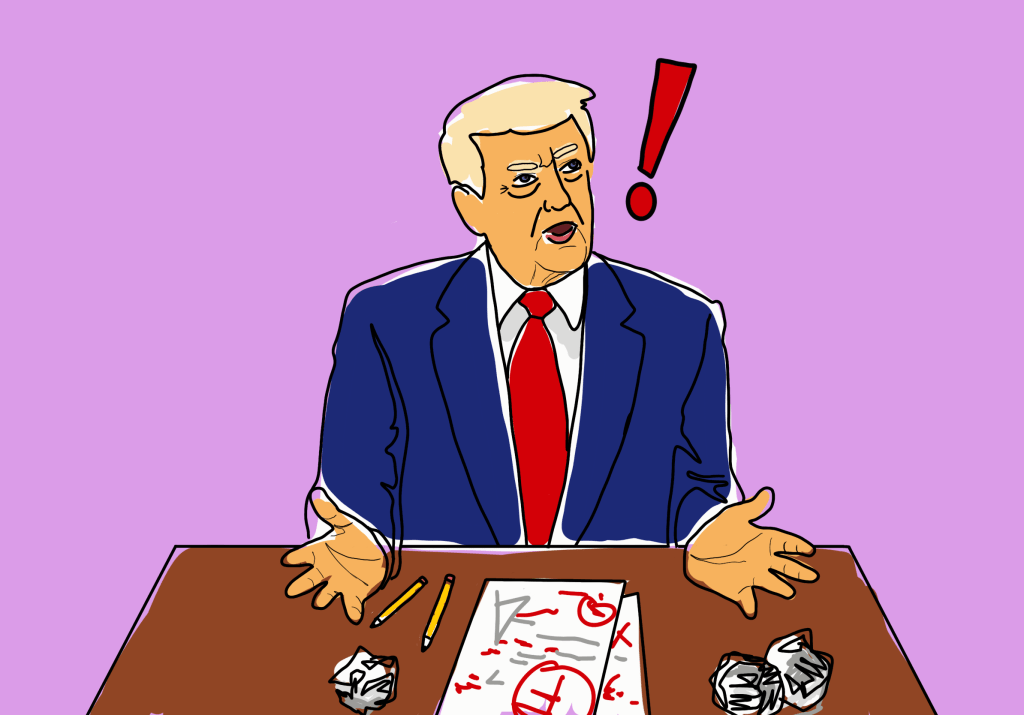
Illustration by Keo Morakod Ung
In April 2025, the Trump administration announced a sweeping set of “reciprocal tariffs” on dozens of trade partners, igniting heated debate and steep market turbulence. Officials framed these moves as an objective remedy for longstanding U.S. trade deficits, claiming they would close the gap between imports and exports through a specific calculation. Yet many observers warned that a tidy equation cannot fully capture the realities of complex global commerce, particularly when the parameters used are highly contentious.
Some of the formula’s details were published in an official memorandum on the Office of the U.S. Trade Representative website. According to that document, the change in tariff rate for each country (Δτᵢ) was derived by comparing the bilateral trade deficit with total imports, then applying an elasticity of import demand (ε) and a tariff pass-through rate (φ). This was typically expressed as:

Here, Δτᵢ denotes the required tariff change on imports from country i; xᵢ and mᵢ represent total U.S. exports and imports with the country, respectively. The formula also includes two parameters: elasticity of import demand (ε), set controversially at 4, and the tariff pass-through rate (φ), fixed at 0.25. The latter refers to the proportion of a tariff’s cost that is reflected in final import prices, serving as an indicator of how much of the burden is absorbed by foreign producers versus passed on to U.S. consumers. The administration argued that persistent deficits would vanish if higher tariffs reduced imports sufficiently to match exports.
Analysts were quick to point out apparent missteps. Economists from the American Enterprise Institute explained on CNN how setting a quarter of tariffs’ cost to pass through to import prices (φ = 0.25) is unusually low. Research based on historical U.S.-China duties often puts pass-through far closer to full levels. Overstating how readily consumers might avoid extra costs led to inflated final tariff figures. Vietnam, for instance, faced a 46% tariff rather than a more modest 12% if more realistic assumptions had been applied. Such a difference was never trivial: BBC reported that the S&P 500 dropped by over ten percent immediately after the policy’s unveiling, citing investors’ shock at the rate hikes and concerns about looming retaliation.
Critics also challenged the formula’s elasticity of import demand (ε = 4). Supporting documents cited older studies by Broda and Weinstein or Simonovska and Waugh, while economists at the Peterson Institute for International Economics insisted that real-world elasticity might be substantially lower. If officials assume goods imports fall much faster per unit of price change, it becomes easier to justify imposing big tariffs. The Financial Times ran commentary suggesting that a formula can quickly turn into a convenient political tool when it uses parameters not grounded in mainstream data.
Beyond those points, many trade experts questioned whether bilateral goods deficits alone prove unfair behavior abroad. Scholars at the Brookings Institution highlighted that U.S. trade balances reflect domestic saving and investment more than they do foreign barriers. A myopic focus on deficits in manufactured goods overlooks America’s substantial surplus in services, where the U.S. holds global competitive advantages in areas such as finance, technology, and entertainment. If the idea were truly to balance trade, focusing on merchandise shortfalls while ignoring services might push policy in counterproductive directions.
Some of the administration’s rationale was spelled out in detail, claiming foreign taxes and regulations weigh heavily on American firms. Even so, the Associated Press reported mounting concerns among exporters in advanced manufacturing, who rely on imported materials. They cautioned that sharply higher tariff burdens could make final products less competitive at home and abroad, thus harming the domestic sectors the policy aimed to protect. At the same time, major economies signalled plans to impose countermeasures if the White House executed hikes at levels near the upper bounds implied by the formula.
These reactions raised another dimension often explored by social scientists: how metrics can steer policy in unintended ways. Because the reciprocal tariff equation emphasizes a singular numeric target, it fails to account for the institutional backdrop of currency fluctuations, bilateral investment treaties, or supply-chain integration. For example, if large multinational firms reroute operations to circumvent a new tariff, the official formula may not meaningfully alter deficits. Instead, the measure could accelerate offshoring to other regions. Meanwhile, legitimate issues like intellectual property theft or anti-competitive practices might remain unaddressed.
Many of those who oppose the new policy do agree that certain foreign barriers warrant action. Yet they propose more targeted efforts, from coordinated negotiations to reformed dispute procedures under organizations such as the WTO. They also suggest that advanced domestic manufacturing cannot be engineered by a single tariff instrument. Strong infrastructure, research and development, and workforce training might do more to revitalize national production than any mathematically neat duty.
Administrations in the past have occasionally deployed apparently rigorous “formulas” to frame trade decisions, giving a veneer of objectivity to outcomes that critics say serve vested interests.In April 2025, this latest formula became a flashpoint of how quantitative modelling can be reshaped by political imperatives. On one hand, it delivered a message of bold action on deficits. On the other, analysts repeated warnings that no equation can rectify what are largely macroeconomic relationships, and that misjudged numbers can stoke volatility, as the markets recently confirmed.
For now, the White House has left the door open to negotiate parts of the policy if trading partners show a willingness to “reciprocate,” meaning a willingness to adjust their own tariffs or lower other barriers. Some wonder if the stated readiness to negotiate is a strategy to extract concessions rapidly, leveraging the threat of sky-high duties as a bargaining chip. But even if it shifts certain negotiations in the short term, broad-based tariff escalation might bring unpredictable side effects, from supply disruptions to rising consumer costs. The formula itself, though presented as definitive, remains contested by academics, businesses, and U.S. allies alike.
Rather than dispute arithmetic alone, critics persist in calling for a deeper look at how trade actually functions in a web of policy, corporate choices, and social needs. The question is whether this reciprocal formula, whether in its original or revised form, can possibly reflect the many interdependencies that shape trade. The events of April 2025 are yet another reminder that economics is not just an applied math exercise. It is a set of judgments about priorities and costs in a world where human relations often resist such simplistic solutions.
 UCL Rethinking Economics