
By Anika Priyaranjan
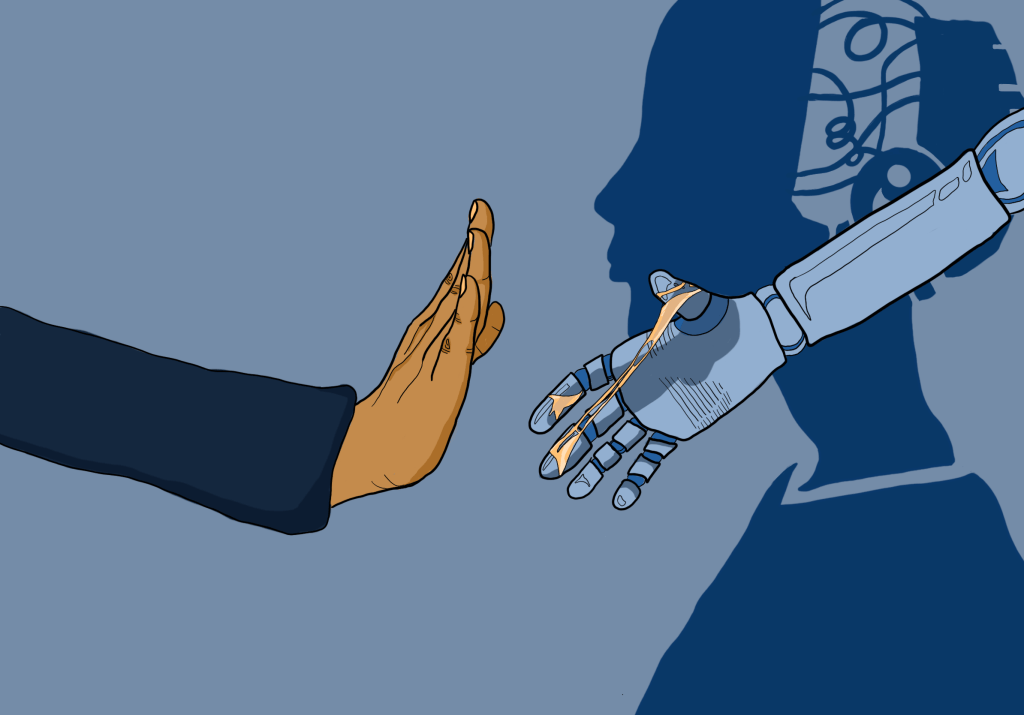
Illustration by Keo Morakod Ung
Artificial Intelligence (AI) is often portrayed as a revolutionary force poised to reshape the world. Advocates claim it will dramatically boost productivity, even if it disrupts millions of jobs. From healthcare to finance and manufacturing, AI applications have driven efficiency and innovation, promising to add up to $15.7 trillion to the global economy by 2030, according to a PwC report. This “AI euphoria” is marked by soaring expectations and massive investments in AI-driven solutions. While AI’s potential is immense, there are growing concerns that the current excitement might lead to a speculative bubble.
As explained in the Guardian, investment bubbles typically unfold in five stages: displacement, boom, euphoria, profit-taking, and panic. The AI bubble began with the displacement stage, sparked by the advent of transformative technologies like ChatGPT. The boom phase followed as AI technologies, including machine learning and computer vision, demonstrated their capabilities across diverse fields. Google’s DeepMind developed an AI system that can diagnose eye diseases with an accuracy comparable to that of expert ophthalmologists. Companies like Tesla and Waymo have been at the forefront of developing self-driving cars, which rely on AI to navigate roads, recognize obstacles, and make real-time decisions, demonstrating the practical application of AI in a field that demands high precision and reliability. However, despite the optimistic projections, we are still in the early stages of a complex, multi-decade transformation. We are now in the euphoria stage, where rationality often takes a backseat to excitement, and companies are investing colossal sums in AI. The next stage, profit-taking, involves astute investors recognizing the overheated market and pulling out before the bubble bursts. Currently, few companies are generating significant profits from AI, except the Magnificent Seven- Nvidia, Apple, Amazon, Meta, Microsoft, and Alphabet.
The risk factors suggesting an AI bubble are mounting. Many AI companies, particularly startups, are experiencing valuations that may not align with their financial performance or market potential. Some firms, despite minimal revenue history, are valued at billions based on future growth projections. An example is OpenAI, which has reached a staggering valuation of $80 billion, largely based on future growth projections rather than current profitability. Resultantly, reminiscent of the dot-com bubble, venture capital is pouring into AI startups, driven by fear of missing out (FOMO), sometimes without a clear understanding of the technology or its market viability.
Panic, the final stage of an investment bubble, may be on the horizon. This stage involves a rapid decline as investors try to exit the market. The overall narrative depends on uncertain assumptions. Possible triggers could include government interventions or growing awareness of AI’s environmental impact; AI technology demands vast amounts of water and energy, and there is a push in both the US and EU for companies to disclose their usage, which could lead to increased costs. Excessive media hype is also a concern. Media coverage that focuses solely on AI’s potential without addressing its challenges can inflate expectations and drive speculative investments. Increased regulatory scrutiny, particularly around data privacy, ethics, and market competition, could slow AI adoption and impact valuations. Many AI applications are still experimental and face significant technical and regulatory hurdles.
Another indicator is the number of AI companies going public at exceptionally high valuations. For instance, C3.ai’s IPO in 2020 saw its stock price more than double on the first day of trading, raising concerns about overvaluation. Moreover, if investment success becomes concentrated in a few high-profile companies while many others struggle, it indicates a bubble. Currently, giants like Google, Amazon, and Microsoft dominate the AI landscape, potentially overshadowing smaller, innovative firms.
Concludingly, the AI euphoria, driven by the technology’s transformative potential, is a double-edged sword. While it promises significant advancements and economic benefits, it also risks inflating a speculative bubble. Recognizing the risk factors and indicators can help stakeholders balance innovation with prudence, ensuring a sustainable and beneficial AI revolution. As is the widespread suggestion, the current investment frenzy in generative AI might be overestimating the demand for chatbots and other AI tools, similar to past over-investment in new technologies.
Ultimately, nothing grows exponentially forever, and the most likely outcome is that the AI bubble will burst. The key is to navigate this transformative period with a balance of enthusiasm and caution, avoiding the pitfalls of unchecked speculation.
 UCL Rethinking Economics