
By Prachi Saraf
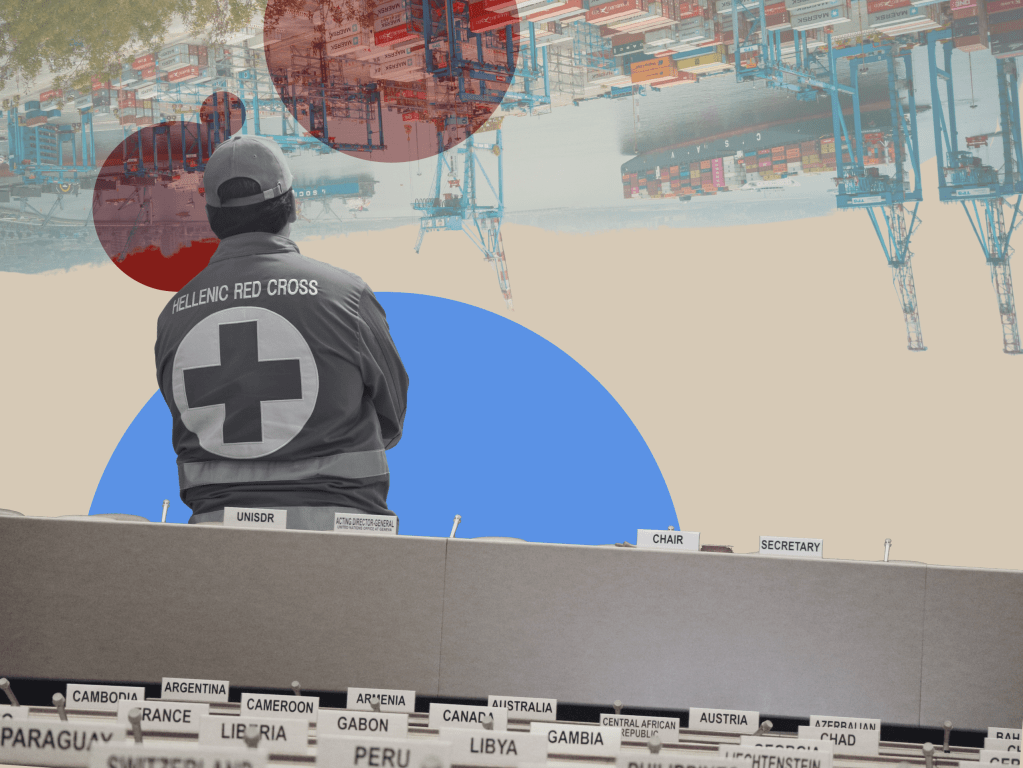
Illustration by Keo Morakod Ung
An Overview of International Aid Today
International aid is a key tool through which developed countries can provide support to developing countries in navigating issues they are not able to deal with independently.
Aid can be divided into two main categories:
1) Humanitarian aid, provided as a response to emergencies such as natural disasters and conflict, and
2) Development aid, focused on promoting social and economic welfare in developing countries.
One known indicator to measure development aid specifically is provided by the OECD’s Development Assistance Committee (DAC), a forum of 32 member countries able to provide aid to recipient countries. ‘Official Development Assistance’ (ODA) is a measure of foreign aid, defined as ‘resource flows to countries and territories’ with ‘the promotion of economic development and welfare as the main objective’.
This can be sent in the form of financial aid, such as a gift or grant, or resources such as technical aid, or military capability. This can be sent by countries individually, through multilateral organisations such as the World Bank, or international non-profits such as the British Red Cross. Currently, the biggest donor countries in gross terms are the United States, Germany, the UK, Japan and France. However, the US is a small contributor relative to Gross National Income (GNI).
The OECD’s target for DAC countries is for donors to invest 0.7% of their GNI target, however as of 2023, only five countries have achieved this target, with the highest donors of ODA relative to GNI are Norway, Luxembourg, Sweden and Germany .
Whilst aid has increased significantly in recent years with 2023 marking a record-high level of ODA, with aid making up 0.37% of the combined GNI of DAC countries, over the last decade this has not risen much, with aid as a share of GNI being 0.31% in 2010. .
Further, some donor countries, including France, have substantially reduced their development assistance since 2022, despite the continued need for aid internationally.

Source: Focus2030
This issue is significant as top recipients of ODA, such as India, Bangladesh and Afghanistan, still require substantial support from aid initiatives, especially amidst the more recent challenges posed by climate change and conflict, which can hinder development progress. Current aid provisions do not seem to be effectively evolving or adapting to meet international development needs.
However, this also raises the question of whether increasing the amount of development aid would indeed be effective in promoting economic growth and reducing poverty in developing countries.
Assessing the Effectiveness of Aid
In the debate about aid effectiveness there are a few different views to consider. In order to assess the true effectiveness of aid measurably, we can look to econometric analysis. This approach presents key models and theories to evaluate outcomes, offering insights for future policy.
It is true that aid initiatives and programmes can have positive impacts on local communities, helping to reduce poverty or boost economic growth. Burnside and Dollar’s econometric analysis (2000) found that aid has had a more positive impact on growth in ‘good policy environments’ (p864).
However, there are some caveats: the article argues that aid is effective conditional on ‘good’ policies, highlighting the need for a complementary environment for policy effectiveness. Further, their definition of the success of aid hinges on positive economic growth. However this is a narrow and reductive image of success; other factors, such as improved health outcomes, reflected in metrics like increased life expectancy and reduced infant mortality rates, also reflect positive impacts.
There are other significant challenges and critiques regarding the effectiveness and micro-level impact of aid.Some critics believe that the current level and type of aid are not sufficient and need improving. They believe that current levels of aid provided are insufficient in meeting the needs of developing countries in the right areas or taking all factors into consideration, including environmental factors. For example, an article assessing the World Bank’s projects suggests that poverty reduction strategies tend to focus on rural areas, especially in Africa with lower urbanisation levels. However, ~80% out of the 49.5% of the Sub-Saharan African population are poor and living in rural areas, and there is increased rural-urban migration (p11). In this way, aid strategies should also consider the effect of such phenomena (p22).
Another view is that aid can be ineffective, and in some cases, harmful, having unintended consequences such as inadvertently fostering corruption, creating dependency and affecting the dynamics of local economies and industries. For instance, if donor countries do not support recipient countries with the allocation of the aid, in ineffective bureaucracies, the aid may rather help corrupt dictators misuse the money. Additionally, foreign aid in the form of food aid can destroy local farm industries in developing countries. As illustrated by supply-demand mechanisms in economics, sending food aid increases the supply in the locality, which can lead to a decrease in the prices for local food sellers and farmers, in turn impacting their ability to sustain their livelihoods.
These arguments demonstrate the multifaceted and complex nature of aid, highlighting how aid does not always fulfil its intended development goals.
Reflections and the Future of Aid
Overall, there is evidence that aid can be beneficial, and developed nations should definitely continue providing budget support. However, aid on its own is not sufficient to lift developing nations out of poverty. Other tools can help with this, such as changing trade policy. Aid strategies need to adapt and be specific to the needs of each country’s situation, with more thorough assessments and increased monitoring to increase aid effectiveness. By fully harnessing the power of international aid and complementing it with other measures, we can help create a level playing field for the developing world.
The images pictured do not belong to UCL Rethinking Economics and are courtesy of:
Cargo image via David Vives on Unsplash (via free licensing)
https://unsplash.com/photos/blue-and-red-cargo-ship-on-sea-during-daytime-zLcV9nXr2y0
Hellenic red cross worker via Sophia Sideri on Unsplash (via free licensing)
https://unsplash.com/photos/man-in-red-and-white-nike-jersey-shirt-YgqW976-u3Q
UNISDR meeting via Davi Mendes on Unsplash (via free licensing)
https://unsplash.com/photos/a-room-filled-with-lots-of-tables-covered-in-signs-c7ir2Go9qXc
 UCL Rethinking Economics