
By Anika Priyaranjan
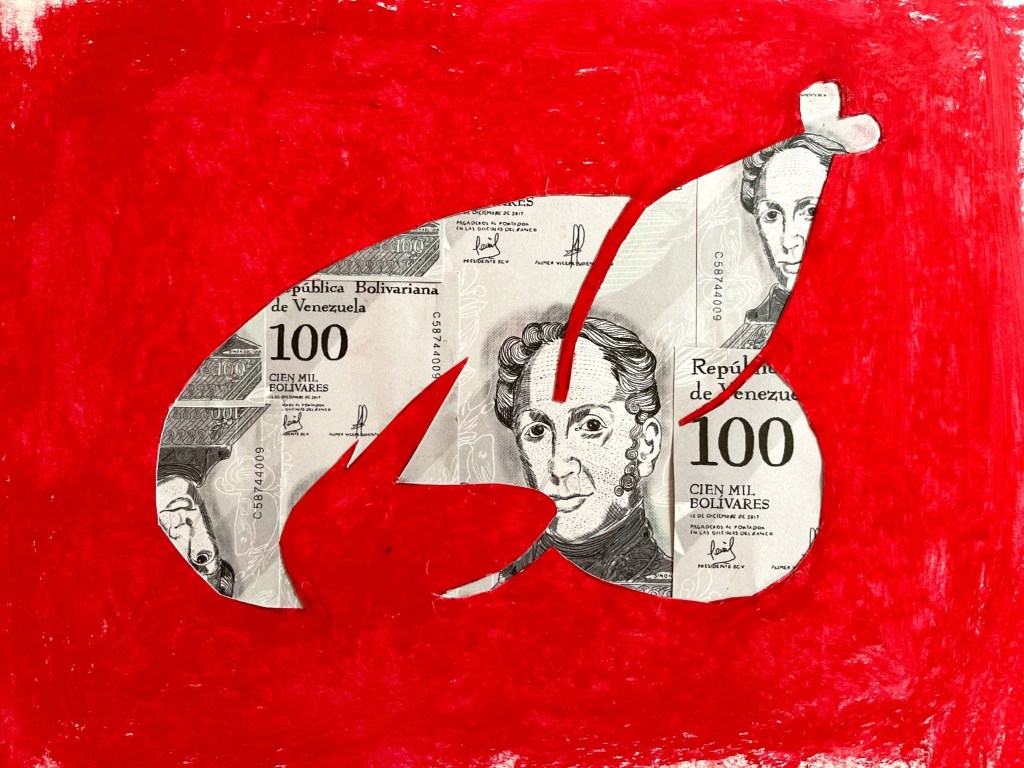
Illustration by Keo Morakod Ung
Venezuela, once one of Latin America’s most prosperous nations, has become a cautionary tale of economic disintegration and hyperinflation. In 2018, Forbes reported that Venezuela’s annual inflation rate reached a staggering 80,000%. Hyperinflation occurs when a country experiences extremely rapid and out-of-control inflation, eroding the real value of its currency and destabilising the economy. The convention, as defined by Phillip Cagan in his 1956 article “The Monetary Dynamics of Hyperinflation,” occurs when inflation exceeds 50% for at least thirty consecutive days. In Venezuela, hyperinflation has persisted at critically high rates, perpetuating economic chaos.

(Source: Forbes)
The roots of Venezuela’s hyperinflation are complex, involving an over-reliance on oil exports, mismanagement of the economy, and widespread corruption. As a petrostate, oil once accounted for 96% of Venezuela’s exports. The steady rise in oil prices since 1998 significantly boosted the country’s revenue. In 2003, a labour strike at the state-owned oil company PDVSA crippled the economy. Hugo Chávez implemented measures to stabilise the weakening Bolivar, including the introduction of a currency peg, the nationalisation of other industries, and the establishment of subsidies for food and consumer goods. While these actions provided short-term relief, they laid the groundwork for future inflation crises.
When global oil prices plummeted in 2014, Venezuela faced a severe revenue shortfall. Unlike the shock experienced in 2003, the reliance on imports for consumer goods had increased during the oil price boom, while domestic production had decreased due to increased regulation and inefficient operation of nationalised industries. The crash in oil prices led to a scarcity of many products because the foreign demand for the bolivar fell, devaluing the currency and increasing the cost of imports. When Nicolás Maduro succeeded Chavez as President in March 2013, he resorted to printing money to cover deficits. The dramatic increase in money supply devalued the national currency and triggered hyperinflation. As the government printed more money, the value of the bolívar plummeted, causing prices to rise. When the government resorted to further money printing to pay its bill, this demand-pull inflation created a vicious cycle.
Moreover, price controls and subsidies intended to protect citizens from soaring costs backfired. In order to protect their standard of living, workers demanded higher wages, causing cost-push inflation. Producers, unable to cover their costs under these controls, reduced supply, leading to widespread shortages and further driving up inflation. Additionally, observing rising inflation, the population began to expect future inflation, resulting in higher immediate consumption and spending to avoid higher prices later, making hyperinflation a self-generating process. Political instability and corruption compounded these economic missteps. The lack of robust governance mechanisms exacerbated the country’s economic woes, pushing it further into crisis.
By August 2018, the Venezuelan currency was worth so little that it was more prudent to use cash for toilet paper rather than buy toilet paper. The bolívar has lost nearly all its value, with prices doubling every few weeks at the height of hyperinflation. This currency collapse has plunged millions into poverty as the purchasing power of wages plummeted, making basic necessities like food, medicine, and hygiene products both scarce and prohibitively expensive. In response, millions of Venezuelans have fled the country, seeking better living conditions elsewhere. This mass migration has strained resources in neighbouring countries and precipitated a regional humanitarian crisis. Meanwhile, public services in Venezuela have collapsed under the weight of hyperinflation. Healthcare, education, and infrastructure have deteriorated dramatically, leading to a severe decline in living standards.
The Venezuelan government has implemented several strategies to combat hyperinflation, including easing currency controls, devaluing the official exchange rate, and introducing new currencies like the Bolívar Soberano in 2018. These actions temporarily reduced the gap between official and black-market exchange rates and slightly slowed hyperinflation. However, by mid-2019, the hyperinflationary spiral had resumed, highlighting the shortcomings of these measures. While international aid and loans have offered some relief, their impact has been limited due to the severity of the crisis and ongoing political instability.
Addressing Venezuela’s hyperinflation will require comprehensive reforms across economic, political, and social sectors. Increasingly, there have been calls for economic diversification to reduce the country’s heavy reliance on oil. Although some steps have been taken in this direction, achieving meaningful progress demands significant structural changes and investment. The path to recovery is arduous, but with coordinated and determined efforts, there is hope for a more stable and prosperous future for Venezuela.
 UCL Rethinking Economics