
By Henry Bushell
Illustration by Keo Morakod Ung
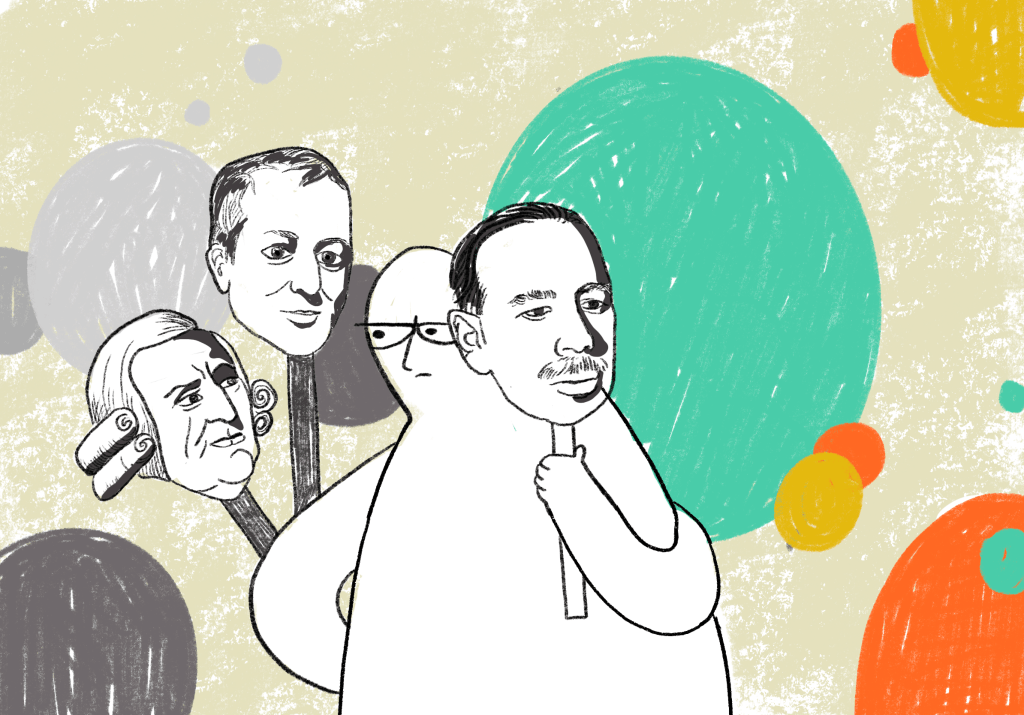
John Maynard Keynes, perhaps the most influential economist of last century, has a line at the end of his famous book The General Theory of Employment, Interest and Money (1936) which I think is underrated in its truthfulness, even in today’s world:
“… the ideas of economists and political philosophers, both when they are right and when they are wrong, are more powerful than is commonly understood. Indeed the world is ruled by little else. Practical men, who believe themselves to be quite exempt from any intellectual influences, are usually the slaves of some defunct economist. Madmen in authority, who hear voices in the air, are distilling their frenzy from some academic scribbler of a few years back”.
This section is worth quoting in full as it captures an idea which, while prevalent in heterodox economics circles, is not fully appreciated by many students and academics – even those interested in economics and politics. So, what is Keynes’ point here?
In his time, economics was dominated by the ‘neoclassical’ school of economic thought. This school of thought was characterised by (noting that this is an oversimplification) advocacy for the free-market and against government intervention and union activity, believing that government intervention in the form of taxation, spending and regulation leads to welfare loss, and that resources are more sensibly directed by the private sector. After the crisis in Keynesian economics in the 1980s led to the revival of neoclassical economics as the major Western economic theory (or what is referred to as orthodox economic theory), we are once again in a position where governments across the developed world are comprised of, and advised by, economists solely trained in the neoclassical tradition.
For Keynes, the ‘madmen in authority’ are these politicians and policymakers in charge of coordinating the country, and the ‘ideas of economists’ from which the ‘world is ruled’ are the dominant theories and values which make up the field of economics. In the 21st century, orthodox economics manifests itself in politics in two main ways: there is an unwavering focus on economic growth, paired with the necessity of limiting government spending. At election-time, the most serious debates revolve round how these two goals will be met by either party. Policy is seen as needing to promote growth in GDP and balanced budgets above all else, with inequality, (particularly financial) stability and environmental maintenance seen as lesser objectives.
Take into consideration financial instability: Dutch economist Dirk Bezemer notes that there were many economists who predicted 2008’s Great Recession, however none of them did so using the neoclassical framework. In other words, those who forecasted the recession all used different economic frameworks to the one that is dominant today. It is well known the long-lasting damage caused by the financial sector’s failure across the world; the fact that neoclassical economic theory was unable to predict or prevent this crisis, especially when other frameworks did predict it, is indicative of a considerable shortcoming of neoclassical theory.
For ecological economists, another key factor where neoclassical theory has an important blind-spot is when it comes to the environment. Aside from some externality analysis which has been included in microeconomics in recent years, orthodox theory contains very little analysis which concerns ecological and environmental factors. Economics aims to study how best we can allocate resources to satisfy human wants and needs; sustaining the environment is necessary for resources to be continually produced, yet this is often sidelined in mainstream theory (please see Rethinking Economics’ UK National Report for more information). Instead, the focus on unbounded GDP growth in a bounded ecological system arguably acts against the common interest of protecting our environment.
This piece is critical of the neoclassical economic tradition, however the problem isn’t with this school of thought as such – there are many powerful insights to be gained using this framework. Instead, the problem is the lack of pluralism in the economics discipline as a whole: practically only neoclassical economics is taught at university in the UK and USA, alongside many other countries. As a result of this, all decisions made are viewed through the lens of this theory, meaning that insights from other schools of thought are largely missed. The last three major British Chancellors, two Conservative and one Labour, all received the same orthodox economics education at Oxford, with this course being called ‘the degree that runs Britain’ – this is symptomatic of the one-track thinking which dominates the UK’s policy-making today. The truth is that unless economics education at major universities is changed from the ground up, this will continue to be the case and government and central bank policy, no matter who is in charge, will be constrained by the method of thinking outlined above. What I have written about in this piece is not an unpopular idea among economists – famous economist Paul Samuelson is quoted as saying “I don’t care who writes a nation’s laws … if I can write its economics textbooks”. In a similar vein, economist Ha-Joon Chang likens the role of economic theory to the role of catholic theology in medieval Europe, fundamentally shaping the way policymakers and people more widely view the world. Is it time, then, for a modern-day Reformation?
 UCL Rethinking Economics