
By Neha Arvind
Illustration by Keo Morakod Ung
I was in London on the 13th of September, the day of Tommy Robinson’s “Unite the Kingdom” march, where thousands of anti-immigrant protestors strode around London Bridge. On the train, there were hundreds of stickers saying, ‘Patriotism isn’t racism’ plastered on a St George’s Flag. To complement that, on the other side of the platform were approximately 20 white males swearing at any person-of-colour on my side of the platform. Such people represent the most dangerous voters in the UK – racist, uneducated, and angry.
Europe has seen a wave of far-right figures in the last few years, including Marine Le Pen of France, Martin Sellner of Austria, and Tommy Robinson of the UK. In mid-2024, around 52% of British people considered the far-right an imminent and big threat to the UK. This has undoubtedly increased since, with rising violent protests expressing approval for Reform UK, who, I believe, manipulate information to incite those irrational enough to believe it.
So, let’s debunk all the lies and myths that the far-right has spread about immigration:
- “Immigrants are taking all the jobs.”
Lie. Immigrants create more demand for goods and services and build businesses in the UK, thus by nature generating more jobs in the economy – a point conveniently ignored out by the far-right. In December 2024, there was net migration of 431,000, a drop from 2022 and 2023. Immigrants are estimated to have contributed £20 million annually, with an overall contribution of £6.6 billion to the UK’s GDP. They bring new ideas, innovative technologies, services, and skill sets that benefit the UK. In fact, a study conducted by the Centre of Research and Analysis of Migration at University College London showed that immigrants are more likely to begin businesses, thus stimulating the economy comparatively more than native citizens.
.
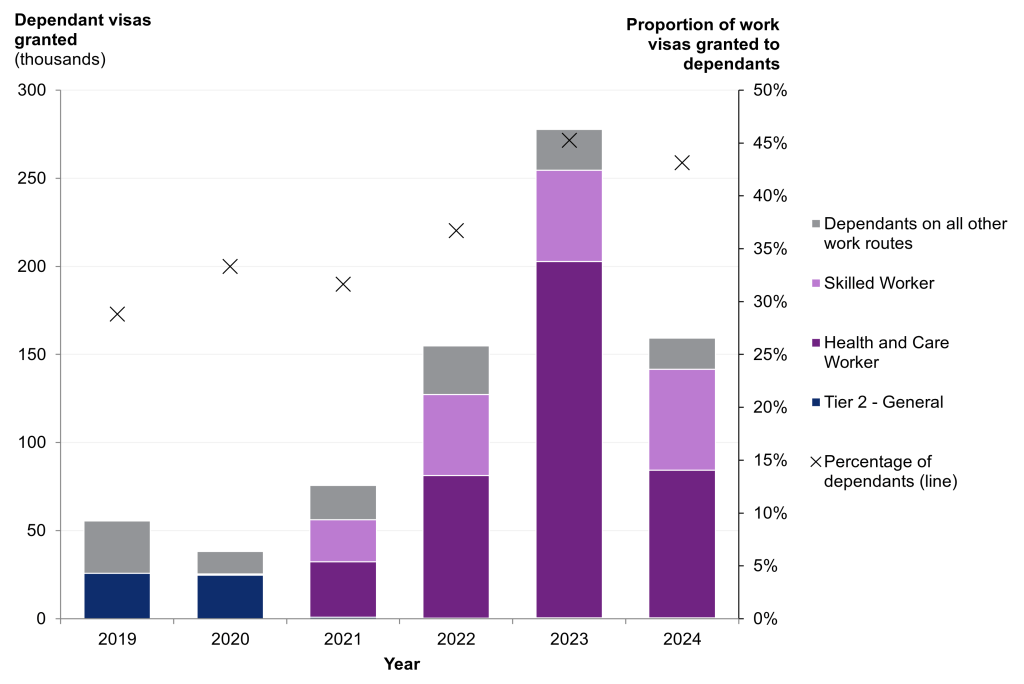
The NHS itself has been fuelled by immigrants and native citizens alike, with roughly 20% of the NHS workforce consisting of the former in early 2024. However, the UK government, who are attempting to constrain immigration, have significantly reduced visa acceptance rates (see figure). There has been an 81% fall in accepted ‘Health and Social Work’ visas to 27174, in 2024, which will impact the number of healthcare professionals available.
Therefore, if an immigrant has ‘stolen’ your job, chances are you were underqualified anyway.
- “Immigrants are putting too much pressure on national services and taking all the benefits.”
Firstly, we ought to clarify who receives Universal Credit. Immigrants who have ‘NRPF ‘(no recourse to public funds) on their visa will not get anything from the government. The group that does receive benefits tend to be asylum seekers and refugees – immigrants who would otherwise be homeless without these funds. In July 2025, nearly eight million people received Universal Credit and, of those, 83.6% were British and Irish nationals. In fact, asylum seekers receive limited state support but are mostly unable to get welfare benefits. Combining with studies suggesting that, on average, migrants contribute more to public finances than the local population over time, migrants, if anything, have a net positive impact on public finances. So again, another lie.
In the previous paragraph I argued why the NHS needs immigrants, however it is also important to note that, according to the NHS confederation, current evidence indicates immigrants do not increase pressure on the NHS. Rather, they are crucial to its functioning, providing several skilled healthcare professionals and greater revenue for operations. Again, the far-right lie – the one thing they can deliver.
3. “Illegal immigrants are dangerous for this country.”
As of June 2025, the UK recorded 111,984 asylum applications, with a significant proportion arriving via boats. The majority of these are seeking refuge from dangerous and uninhabitable conditions in their home country. For instance, many Afghans are presently escaping Taliban rule. Whilst tragic cases have existed whereby asylum seekers have committed serious crimes, such incidents have been selectively utilised to tarnish perceptions of the entire group, weaponising prospective oppressors – despite limited data supporting their view. Naturally, this is not to dismiss the severity of those crimes, although it is crucial to recognise that most asylum seekers are benignly seeking an opportunity to rebuild their lives. A just, rigorous screening process should be implemented to ensure that individuals with criminal records are denied entry, while allowing genuine refugees the chance to find protection. After all, the UK has historically interfered with most of the countries whose citizens are now seeking refuge.
I will conclude this piece by stating that the commonality amongst all far-right extremists is that, after consuming Turkish kebabs, or being treated by an Indian NHS Doctor, there still exists a lack of education and “primal” fear of certain groups. Yet, the UK government fails to condemn the far-right as they ought to. Even on September 13th, “at least 25” people out of 150,000 protestors were arrested for injuring approximately 26 officers. They were violent, assaulted officers, and damaged property, but still only 25 arrests were made. Contrastingly, during the Palestine Action protest, seemingly more peaceful, 890 arrests were made, predominately of retired people. The contradiction is patently obvious and facilitates the far-right’s growth, spreading harmful rhetoric.
Immigrants are not the cause of Britain’s problems – they are a vital part of its economy, public services, and communities. If we want a stronger, fairer, and safer country, we must confront these lies, demand accountability from both the government and media, and stand firm against the normalisation of extremist, violent rhetoric.
 UCL Rethinking Economics